
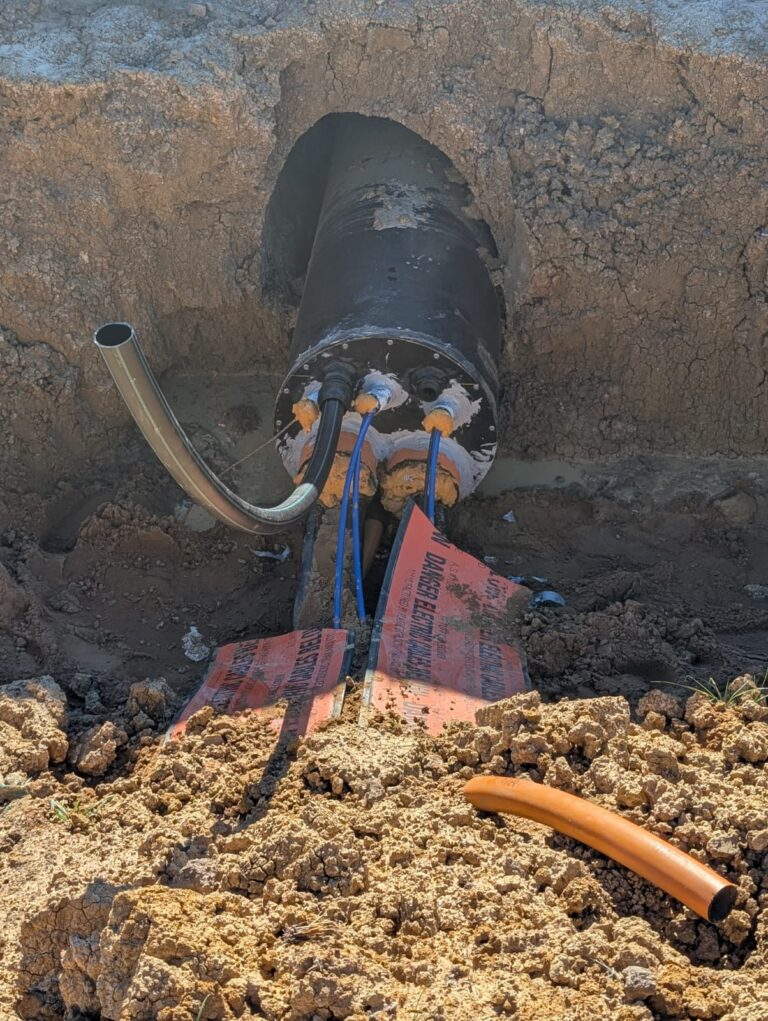
Unique Drilling Services recently completed the trenchless installation of high-voltage electrical crossings for a Victorian Solar Farm — two road crossings and a creek crossing — coordinating the HDD drilling, onsite pipe welding, and specialised low thermal resistivity bore grouting as a single scope under UDS project management.
The works comprised three HDD bores installing 630mm and 400mm electrical crossings:
Bore 1 — 120m of 630mm PE sleeve, carrying 2 x 225mm PE conduits and 3 x 63mm PE conduits.
Bore 2 — 72m of 630mm PE sleeve, carrying 2 x 225mm PE conduits and 3 x 63mm PE conduits.
Bore 3 — 72m of 400mm PE sleeve, carrying 1 x 225mm PE conduit and 2 x 63mm PE conduits.
All pipe strings were welded onsite prior to installation, with each bore then grouted to complete the works.
A PE sleeve was incorporated into the design to preserve the integrity of the product grout, removing any chance of ground contamination that could affect the final thermal rating. The sleeve also provided a mathematically accurate void to fill — eliminating ambiguity around grout quantities and the risk of product loss into the surrounding ground during installation.
The standout requirement on this project wasn’t the drilling — it was the grout.
The design called a Low TR grout with a thermal resistivity of no more than 0.9 K·m/W. In order to preserve the integrity of the cable rating together with the overall performance of the installation, the conduit encasement needs to actively dissipate heat away from the power cables, so the grout itself must be thermally conductive enough to guarantee effective heat transfer for the life of the asset.
A TR value that low is not an off-the-shelf product — only one grout in Australia is currently capable of meeting this specification and application. Sourcing it, proving it, and successfully installing it made this project a genuine milestone for UDS.
Hitting a TR of less than 0.9 doesn’t happen by ordering a product and hoping. The result came from extensive upfront testing and planning:
Mix design and aggregate control. The sand grading was scrutinised down to the sieve fraction, with a maximum nominal aggregate size of 1mm and approximately 93% passing the 0.6mm sieve — ideal for a pumpable grout travelling through small conduits.
Pumpability trials. The product has very high fluidity, behaving almost like a liquid, and was proven capable of being pumped through a 50mm hose over distances exceeding 80m. A 1m³ trial pour was conducted through 75m of 50mm hose before any product went into the works — a deliberate out of range pumping scenario.
Grouting methodology. A 63mm HDPE grout line was installed alongside the sleeve, modified with regular dispersal intervals, with each end of the sleeve dam-walled to contain the pour.
Thermal resistivity testing. Samples were cast and independently tested for thermal conductivity to ASTM D5334 at both 2 days and 28 days. Due to the high cementitious content of the product, the drying-out phase alone took nearly two weeks before the fully dry testing could even begin.
Both 28-day samples achieved a TR value of 0.74 K·m/W — consistent across samples and well below the project requirement of 0.9 K·m/W.
What sets this project apart isn’t just the specification — it’s how it was delivered. Rather than the client having to engage and coordinate separate contractors for drilling, welding, grouting, pumping, and testing, UDS managed the entire program: sourcing and coordinating the specialist contractors, running the trial pours, aligning the pump contractor with the grout methodology, and driving the thermal testing regime that proved the result before a single cubic metre went into the works.
For the client, that meant one point of contact and one party accountable for the outcome — no juggling multiple trades, no gaps between scopes. It’s exactly the project delivery methodology UDS brings to complex, high-skill jobs: pulling the right specialists together and managing them through to a verified result.
For a specification that only one grout in the country can meet, delivering that result with margin to spare is something we’re proud of. It’s the kind of outcome that comes from treating the grout as seriously as the drilling — verified by testing, proven by trial, and installed with a methodology built for certainty.
Another trenchless solution delivered — and a benchmark set for thermally rated HDD installations on Australian renewable energy projects.